
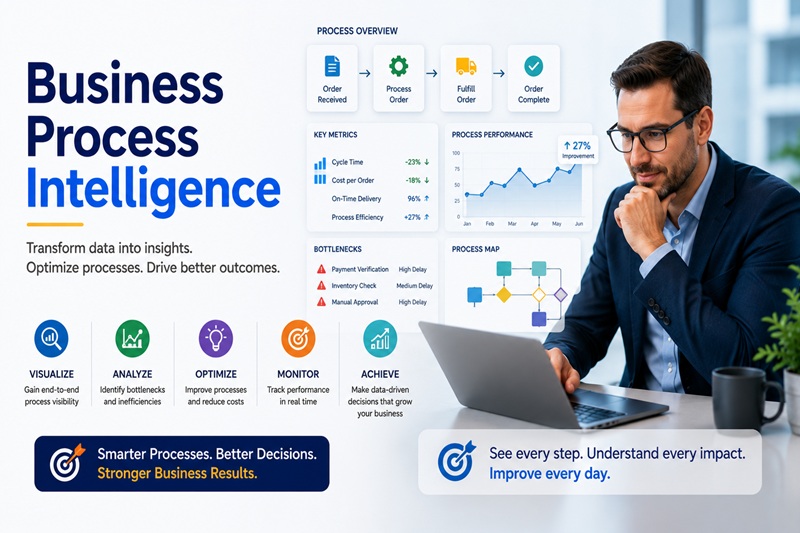
Data has never been more abundant in the business world, and yet a persistent gap exists between the data organizations collect and the operational decisions they make with it. Most companies know what their revenue was last quarter, how many tickets their support team closed, or how many units shipped from the warehouse. What they struggle to know is precisely how those outcomes were produced, where the process broke down along the way, which steps took longer than they should have, and what the real-world sequence of events looked like versus what the process was designed to be.
Business process intelligence exists to close that gap. It is one of the most consequential developments in enterprise operations in the past decade, and as AI and real-time data capabilities have matured through 2025 and into 2026, it has moved from a niche analytical discipline into a mainstream operational capability that organizations across industries are using to find efficiency, reduce costs, and accelerate the value delivered by automation investments.
Defining Business Process Intelligence
Business process intelligence, also referred to as process intelligence or BPI, is the discipline of collecting, analyzing, and monitoring operational data to understand exactly how business processes work in practice, rather than how they were designed to work on paper, and then generating the insights needed to improve them continuously.
The foundation of BPI is process mining, a data-driven approach that uses event log data extracted from systems like ERPs, CRMs, and case management platforms to construct a visual, data-grounded model of how a process actually flows. This model reflects real transactions, real sequences, real timing, and real deviations rather than the idealized flowchart that someone drew during a process design workshop years ago. From this model, organizations can see exactly where cases get stuck, how frequently process paths deviate from the intended design, which steps are driving the most cost or delay, and where automation would generate the highest return.
Once that foundational model is built, process intelligence layers in continuous monitoring and AI-powered analysis that keeps the picture current in real time rather than relying on periodic manual assessments. As Appian describes it in its enterprise process intelligence platform documentation, process intelligence provides a comprehensive view of how your organization operates at every level, from individual day-to-day tasks to overarching business performance, and it does so in a way that allows both operational managers and strategic leaders to act on what they see rather than simply observe it.
How Business Process Intelligence Differs From Business Intelligence
The distinction between business process intelligence and traditional business intelligence is worth understanding clearly because the two disciplines are frequently confused, and that confusion leads organizations to expect capabilities from one that only the other can provide.
Traditional business intelligence is fundamentally retrospective and outcome-focused. It tells you what happened: revenue by region, customer churn rate, inventory turnover, support ticket volume. It is essential for performance monitoring and strategic reporting, and virtually every organization of any size uses some form of it. What it cannot do is explain the operational sequence that produced those outcomes. A BI dashboard can show you that your accounts receivable days outstanding increased by eight days this quarter. It cannot show you where in the order-to-cash process that delay was generated, which step created the backlog, or how the actual process deviated from its intended design.
Business process intelligence answers those operational questions directly. As Celonis, one of the leading platforms in the process intelligence space, explains, BI tells you your KPIs. Process intelligence tells you why those KPIs look the way they do and what needs to change operationally to move them. The two disciplines are complementary rather than competitive. Many organizations that combine them report that the strategic insights from BI and the operational insights from process intelligence together give them a genuinely complete picture that neither provides alone. According to research, 50 percent of organizations already use process intelligence tools, and the integration of both disciplines is accelerating rapidly.
The Core Components of a Business Process Intelligence System
A mature business process intelligence capability is built from several interconnected components that work together to move from raw operational data to actionable decision-making.
Process mining is the data extraction and modeling layer. It ingests event logs from existing systems, the digital footprints left by every transaction and interaction inside your ERP, CRM, helpdesk, or workflow platform, and uses algorithms to reconstruct the actual flow of each process case. The output is not a theoretical model. It is an empirically derived map of what your processes are actually doing across thousands or millions of real instances.
Task mining adds a complementary layer of granularity by capturing what individual users are doing at the desktop level. While process mining shows how cases flow between system steps, task mining shows what human actions are happening within those steps, which applications people use, what sequence of clicks and entries they execute, and how long each element takes. Together, process mining and task mining produce a comprehensive picture of both the system-level and human-level dimensions of how work gets done.
AI-powered analysis transforms the raw process model into prioritized insights. Rather than requiring analysts to manually review process visualizations and hypothesize about root causes, AI algorithms automatically surface anomalies, bottlenecks, compliance deviations, and automation opportunities ranked by their potential business impact. Platforms like KYP.ai have demonstrated concrete outcomes from this capability, with one deployment at Alorica identifying $2.5 million in annual savings and 26 percent automation potential from a single process analysis engagement.
Simulation and what-if modeling allow organizations to test proposed changes before implementing them. A process intelligence platform with simulation capability can model the effect of adding automation to a specific step, changing resource allocation, or resequencing workflow stages, and predict the resulting impact on cycle time, cost, and throughput. This moves decision-making from educated guessing to data-grounded scenario planning.
Continuous monitoring ensures that the insights generated during analysis remain current. Processes drift over time as systems change, teams evolve, and business conditions shift. A process intelligence platform that monitors process behavior on a continuous real-time basis can alert organizations when a process begins deviating from its optimal state before the deviation compounds into a significant performance problem.
Industries Where Business Process Intelligence Delivers the Fastest Returns
While business process intelligence is applicable across virtually every industry that relies on complex, repeatable workflows, certain sectors consistently see the fastest and most substantial return on investment from deployment.
Financial services is one of the highest-value application areas. Banks, insurance companies, and financial institutions run an enormous volume of standardized processes including loan origination, claims processing, account opening, and compliance reporting. Even small inefficiencies in these workflows, multiplied across millions of transactions, generate significant cost and delay. Process intelligence applied to a bank’s lending process, for example, can surface exactly which steps in the approval workflow are generating the most variance in processing time, enabling targeted optimization that reduces cycle time without requiring a complete process redesign.
Healthcare organizations face parallel opportunities. Patient intake, billing and claims submission, discharge planning, and medication management are all processes with well-defined ideal flows that frequently deviate in practice. Process intelligence used in clinical operations settings has demonstrated meaningful reductions in administrative burden, billing error rates, and patient wait times by surfacing exactly where process execution diverges from design and providing the evidence needed to correct it.
Manufacturing and supply chain operations benefit from process intelligence’s ability to connect digital process data with physical production outcomes. Purchase-to-pay, order-to-fulfillment, and inventory management processes all have complex multi-system footprints that traditional analysis tools struggle to capture in their entirety. Process intelligence provides the end-to-end visibility that reveals where supply chain delays are actually generated, which supplier interactions create downstream quality issues, and where manufacturing workflow steps are consuming more time than planned without clear justification.
The Role of Business Process Intelligence in Automation Strategy
One of the most strategically important applications of business process intelligence in 2026 is its role in guiding automation investments. Organizations that invest in robotic process automation, intelligent document processing, or AI-driven workflow automation frequently encounter a frustrating reality: automating a flawed or poorly understood process makes the flaws faster and more consistent rather than eliminating them.
Business process intelligence solves this problem directly by showing organizations exactly which processes are candidates for automation, which steps within those processes are most amenable to automation, what the expected ROI of specific automation implementations will be before any code is written, and how to monitor the performance of automation after it is deployed.
According to Deloitte research, the percentage of enterprise businesses piloting process mining solutions declined from 39 percent in 2021 to 15 percent in 2025, reflecting a shift away from exploratory pilots toward more deliberate, outcome-focused deployments. Organizations have learned that process intelligence initiatives succeed when they focus on processes that are important enough to matter, poorly understood enough to generate genuine insight, and contained enough to show results within a reasonable timeframe. Broad, ambitious pilots that tackle the most complex enterprise processes first tend to overwhelm teams and deliver ambiguous results.
Getting Started With Business Process Intelligence
For organizations evaluating business process intelligence for the first time, the practical starting point is not software selection. It is process selection. Identifying one or two processes that are genuinely important to business outcomes, that you suspect are performing below their potential, and that have accessible event log data in your existing systems gives you the foundation for a focused initial deployment.
The data requirements for process mining are often less daunting than organizations expect. If your process touches an ERP, CRM, or workflow management system, that system is almost certainly generating the event log data that process intelligence tools need. The primary technical requirement is the ability to extract and connect that data, which leading platforms are increasingly able to do through pre-built connectors to SAP, Salesforce, ServiceNow, Microsoft Dynamics, and other common enterprise systems.
The organizations that build lasting competitive advantage from business process intelligence are those that treat it not as a one-time analytical exercise but as a permanent operational capability. Processes do not stay optimized. Systems change, teams evolve, and business conditions shift. Continuous process intelligence that monitors operational performance on an ongoing basis and surfaces emerging deviations early is what separates organizations that sustain operational excellence from those that achieve it briefly and then watch it erode.