
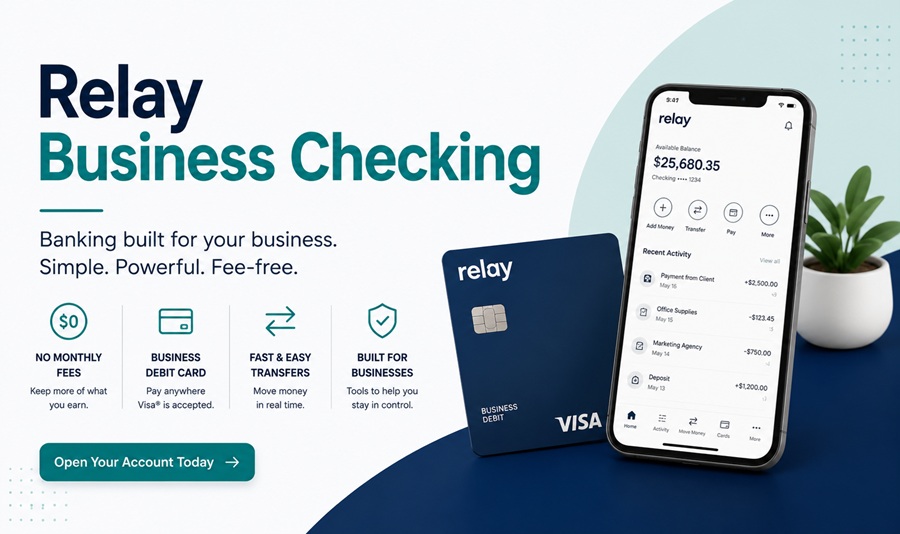
Finding a business checking account that genuinely works for a small business rather than just tolerating one is harder than it sounds. Most traditional banks offer business accounts designed around the needs of larger commercial clients, with fee structures, minimum balance requirements, and feature limitations that make them poorly suited to freelancers, startups, service-based businesses, and the growing ranks of small business owners who manage their finances digitally without a dedicated finance team. Relay has emerged as one of the most talked-about alternatives in this space, and for good reason. It is purpose-built for small business financial management in a way that most traditional and even most digital-first banking platforms are not.
This is a thorough, honest review of Relay business checking based on current 2026 data, covering what the platform does well, where its limitations become relevant, and who it is genuinely the right fit for.
What Relay Actually Is
Relay is a financial technology company, not a bank. It provides business banking services through a partnership with Thread Bank, a member of the FDIC. Deposits held in Relay accounts are FDIC insured, with standard coverage of $250,000 per depositor and an extended coverage of up to $3 million available through Thread Bank’s deposit sweep program, which places funds across a network of FDIC-insured institutions. That $3 million coverage threshold is twelve times the standard $250,000 limit and meaningfully exceeds what most small business owners will ever need.
Relay was founded with a specific mission: to give small business owners greater clarity and control over their finances through a digital-first platform that eliminates the friction and fees that traditional business banking typically involves. The platform has built a particularly loyal following among accountants, bookkeepers, and business owners who use the Profit First cash management method, for reasons that become clear when you dig into the account structure.
The Feature That Makes Relay Different: Twenty Free Checking Accounts
Most business banking platforms offer a single checking account, occasionally with the option to add subaccounts for an additional monthly fee. Relay offers up to twenty individual checking accounts on its free Starter plan, with no monthly maintenance fees, no minimum balances, and no overdraft fees across any of them.
This is not a cosmetic feature. It is a structural financial management tool that changes how small business owners can relate to their money. Rather than managing a single account balance that obscures the true availability of funds across different obligations, Relay allows business owners to physically separate money by purpose. One account holds incoming revenue. Another holds funds allocated for taxes. A third covers operating expenses. A fourth holds owner’s pay. The balance in each account reflects exactly what is available for that specific purpose at any given moment, eliminating the guesswork and false confidence that come from looking at a single pooled balance.
This architecture is the reason Relay has become the go-to banking platform for practitioners and adherents of the Profit First method, developed by Mike Michalowicz, which prescribes exactly this kind of physical fund separation as the foundation of healthy small business financial management. As NerdWallet’s 2026 review of Relay business banking notes, users can get significant value from Relay’s free checking account through tools like invoicing, payment links, and low-cost wire transfers, making it an excellent choice for digital-first business owners who prioritize financial organization without paying for it.
Automated Cash Flow Allocation
Beyond the multi-account structure itself, Relay offers automated transfer rules that make the fund separation process virtually frictionless. Business owners can set rules that automatically move a defined percentage of every deposit into their designated accounts the moment revenue lands. An owner following Profit First allocations, for example, can configure Relay to immediately route 5 percent of every deposit to a profit account, 15 percent to a tax account, and specified percentages to owner’s pay and operating expenses, without manual transfers each time revenue comes in.
This automation addresses one of the most common failure modes in small business cash flow management: the intention to allocate funds appropriately that never gets executed because the process is manual, tedious, and easy to defer. Relay removes the human bottleneck from that process entirely.
Pricing: Free Starter Plan and a Paid Grow Tier
Relay operates a two-tier pricing model. The Starter plan is genuinely free, with no monthly maintenance fee, no minimum balance requirement, and no overdraft charges. This plan includes up to twenty checking accounts, up to two savings accounts earning up to 2.68 percent APY, up to fifty physical or virtual debit cards, ACH transfers, direct deposit, mobile check deposit, and integrations with QuickBooks Online and Xero. For most small businesses, the free Starter plan provides everything they need.
The Grow plan, priced at $30 per month, adds features including free outgoing domestic and international wire transfers, automated bill payment with auto-import from QuickBooks and Xero, same-day ACH transfers, and priority customer support. The wire transfer savings alone can justify the Grow plan cost for businesses that regularly send wires, since domestic wire transfers run $5 each on the free plan and international wires cost $10 each.
Accounting Software Integration
Relay’s integration with QuickBooks Online and Xero is deeper than the standard bank feed connection most financial institutions offer. Because each of Relay’s twenty checking accounts generates its own distinct bank feed in both platforms, bookkeepers can manage client finances with significantly greater precision. Every transaction arrives already mapped to the correct budget category based on which account it flowed through, eliminating a meaningful portion of the manual categorization work that consumes bookkeeping hours.
Relay also supports seven distinct permission levels for team members and external advisors, including a read-only level for reporting purposes and a bill-payer level that allows bookkeepers or accounts payable staff to process payments without accessing the master account funds. This granularity of access control is something most small business banking platforms do not offer and it makes Relay a practical fit for businesses that want to delegate financial tasks without surrendering full account access.
The Debit Card and Spending Control Features
Relay allows businesses to issue up to fifty physical or virtual debit cards on a single account, with granular spending controls that can be applied to individual cards. Owners can set merchant-category restrictions, such as limiting a card to fuel purchases only, set transaction limits, and instantly freeze or unfreeze any card through the mobile app. For businesses with multiple team members making purchases on behalf of the company, this level of spending control replaces the awkward workarounds of shared card numbers or petty cash reimbursements with a more structured and auditable system.
The iOS app carries a 4.8 rating and the Android app a 4.5 rating, with users consistently highlighting biometric login, real-time transaction alerts, and instant card freeze as the most valued mobile features.
Honest Limitations Worth Knowing Before You Open an Account
No banking platform is perfect for every business, and Relay has a set of genuine limitations that are worth understanding clearly before opening an account.
Cash deposits are not available directly through Relay. The platform is digital-first by design, and businesses that regularly handle physical cash, including retailers, restaurants, and service businesses with significant cash-paying customers, will find this a meaningful operational gap. Relay is not a practical primary banking solution for cash-intensive businesses.
Mobile check deposits can take seven to ten business days to clear, which is significantly longer than most traditional banks and some competing digital platforms. For businesses that receive a meaningful volume of check payments and need fast access to those funds, this clearing timeline can create cash flow friction.
Relay does not support Zelle natively, which limits peer-to-peer payment options for businesses whose customers or vendors prefer that platform. Workarounds exist but add friction.
In 2024, Thread Bank, Relay’s partner banking institution, received an FDIC enforcement action related to suspicious activity monitoring and due diligence requirements in its banking-as-a-service program. That enforcement action was terminated by the FDIC in December 2025 after Thread Bank took corrective measures. The episode is worth noting as context for any business evaluating the risk profile of a fintech-plus-partner-bank structure, even though the matter has been resolved.
Some users report that account freezes, while infrequent, can occur without clear advance notice and that resolving them through customer support takes longer than expected. This is a risk inherent to digital banking platforms that use automated compliance monitoring rather than the relationship-based oversight of a traditional banker who knows your business.
Who Relay Is the Right Fit For
Relay business checking is genuinely excellent for a specific profile of business owner. Freelancers, consultants, agencies, service businesses, and digital-first operators who manage their finances online, receive revenue primarily through ACH transfers, card payments, or invoices, and want a structured, fee-free way to organize their cash flow will find Relay one of the best-designed banking solutions available at any price point.
It is a particularly strong fit for business owners who follow the Profit First method or any other allocation-based approach to cash flow management, since the multi-account structure and automated transfer rules make those methods far easier to execute consistently.
It is a poor fit for businesses with significant cash transaction volume, those who need same-day check clearing, or those who require the kind of complex lending relationships and in-person service that only a traditional bank can provide. For those businesses, a regional bank or credit union with established small business lending capabilities will serve better.
Relay’s Trustpilot rating of 4.7 out of 5 stars, drawn from a substantial volume of reviews, reflects a user base that is largely satisfied with the platform’s core proposition: a free, well-designed, multi-account business checking solution that makes cash flow management genuinely easier without charging for the privilege.
This article is for informational purposes only and does not constitute financial advice. Please consult a qualified financial professional before making banking decisions for your business.