
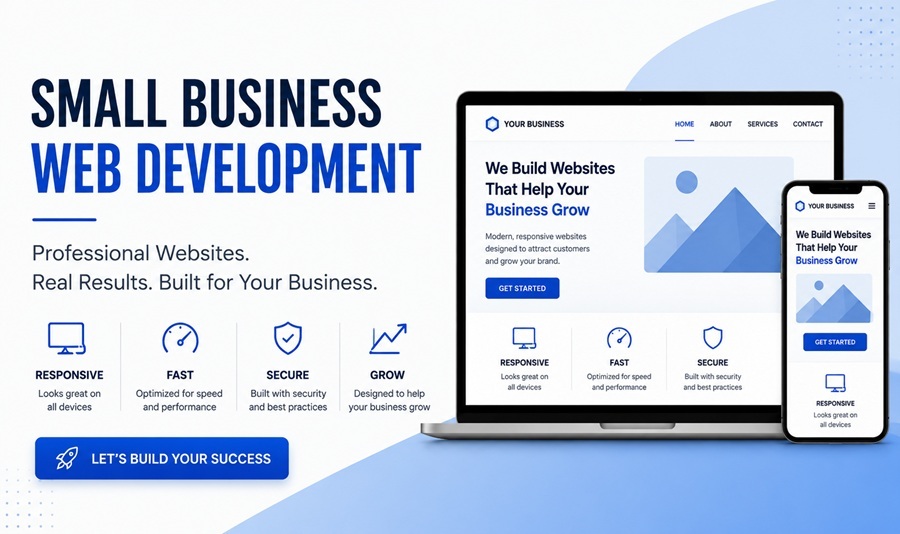
A small business without a website is not invisible. It is simply handing customers to competitors who understood earlier that the internet is where buying decisions begin. According to recent research, 27 percent of small businesses in the United States still lack a website entirely, and among those that do have one, a significant portion have sites that load too slowly, display poorly on mobile, or fail to convert visitors into leads and customers because they were built without a clear commercial objective in mind.
Small business web development in 2026 is not just about having a presence online. It is about building a digital asset that works as hard as you do, generates measurable results, and keeps pace with the technical standards that search engines and users now expect as a baseline.
The Business Case for Getting Web Development Right
Before getting into the how, the why deserves a moment of attention. The global web development market reached $89.3 billion in 2026, growing at 13.7 percent year over year. That investment is not driven by aesthetics. It is driven by commercial outcomes that businesses can measure directly.
Conversion rates on professionally designed, well-performing websites run meaningfully higher than those on poorly built sites. E-commerce businesses report conversion rate improvements averaging 20 percent when page load times drop from three seconds to one second. Research shows that 53 percent of mobile users abandon a site that takes longer than three seconds to load. For a small business generating $500,000 in annual revenue with 30 percent of leads coming through the website, a 20 percent improvement in conversion rate is not a minor detail. It is a significant revenue line.
The reputational dimension matters equally. A site that looks outdated, loads slowly, or breaks on a smartphone signals something specific to prospective customers: that the business behind it does not pay attention to quality or detail. In a competitive market where trust is built before the first conversation, that impression is costly.
Three Paths to Building Your Site: DIY, Freelancer, or Agency
The first major decision in any small business web development project is who will build the site, and the answer depends on your budget, your timeline, your technical needs, and the long-term role the site will play in your business.
Do-it-yourself platforms like Wix, Squarespace, and Shopify have matured significantly and now offer templates, built-in hosting, SSL security, and basic SEO tools that make it possible for non-technical business owners to build a functional site without writing a line of code. Wix plans start at approximately $17 per month, while Squarespace begins at $16 per month billed annually. For very early-stage businesses with tight budgets and relatively simple needs, this is a legitimate starting point. The trade-offs are real: template-based sites have design constraints that limit differentiation, and they tend to underperform on technical SEO compared to professionally built sites as complexity grows.
A freelance web developer is the right choice for businesses that need a custom-designed, professionally built site without the overhead of a full agency relationship. In 2026, freelancers building template-based brochure sites for small businesses typically charge between $3,000 and $8,000, with rates varying depending on experience, location, and project scope. North American freelancers generally charge $80 to $140 per hour for mid-level work, while comparable talent in Eastern Europe typically runs $40 to $70 per hour and in Asia $20 to $60 per hour. Working with an experienced freelancer delivers custom design, proper SEO foundations, and a site built to your specific requirements without the larger price tag of an agency.
A boutique web design agency is the appropriate path for businesses that need a more complex site, want strategic input on user experience and conversion optimization, require project management, or simply want the reliability of a team rather than a single individual. Per the Clutch 2026 survey, 61 percent of small business buyers spent under $10,000 on their most recent website project, but agency builds for small to mid-sized businesses typically land between $8,000 and $15,000 for a template-based brochure site, and between $15,000 and $50,000 for custom development with e-commerce functionality. Most small businesses invest between $5,000 and $15,000 for a professional website in 2026, receiving a modern, responsive, SEO-friendly site with custom design, contact forms, analytics integration, and a content management system.
The Technical Foundation Every Small Business Site Must Have
Regardless of who builds your site or how much you spend, there is a set of technical requirements that every small business website must meet in 2026 to perform adequately in search results and to provide the user experience your visitors expect.
Mobile performance is no longer optional or secondary. Over 60 percent of web traffic now comes from mobile devices, and Google’s mobile-first indexing means the mobile version of your site is what Google crawls, indexes, and ranks. A site that looks fine on desktop but loads slowly or displays awkwardly on a smartphone will underperform in search regardless of how good its content is. Responsive design, touch-friendly navigation, compressed images, and streamlined mobile layouts are baseline requirements for any new build in 2026.
As Google’s Core Web Vitals documentation explains, three specific performance metrics now directly influence search rankings: Largest Contentful Paint measures how quickly the main content of a page loads, with a target of under 2.5 seconds. Interaction to Next Paint measures how quickly the page responds when a user clicks or taps, with a target under 200 milliseconds. Cumulative Layout Shift measures visual stability, penalizing pages where content moves unexpectedly as the page loads. These three metrics, collectively known as Core Web Vitals, are measured using real user data and represent Google’s most explicitly quantified signals about the quality of the user experience your site delivers. Sites with poor Core Web Vitals consistently see higher bounce rates, lower engagement, and lower search rankings than comparable sites with strong performance.
An SSL certificate, which enables the https prefix and the padlock symbol in browser address bars, is a technical necessity that every site must have. Beyond securing data transmitted between the site and its visitors, it is a ranking factor and a trust signal that affects whether prospective customers are willing to engage with your forms or submit their contact information.
What Your Site Needs to Actually Generate Business
A technically sound website that fails to convert visitors into leads or customers has not done its job. The commercial layer of small business web development is where many sites fall short, not because of poor technical execution but because the site was never designed around a clear understanding of what it needs to get visitors to do.
Every page of your site should have a primary purpose and a primary call to action that serves that purpose. A homepage should direct visitors toward the next logical step in the relationship, whether that is contacting you, viewing your services, or making a purchase. A services page should describe your offering in terms of the outcomes it creates for clients, not just a list of what you do, and then ask the visitor to take a specific next step. A contact page should remove every possible friction from the process of getting in touch.
Clear navigation, fast load times, and consistent brand presentation across every page build the low-level trust that moves visitors from curiosity to inquiry. Social proof in the form of genuine client testimonials, case studies, or visible reviews reduces the perceived risk of engaging with a business the visitor does not yet know. A Google Business Profile linked to and consistent with your website improves local search visibility and gives visitors a second credible touchpoint to verify that your business is legitimate and operational.
The Ongoing Costs That Most Business Owners Underestimate
One of the most common mistakes small businesses make with web development is budgeting only for the initial build and treating the website as a fixed cost once it launches. A professional website requires ongoing investment to remain secure, current, and effective.
Annual ongoing costs for a professional small business site in 2026 typically range from $3,600 to $24,000, covering hosting, security maintenance, software updates, performance monitoring, analytics review, and iterative content and design improvements. Businesses that budget only for the initial build frequently see their site decay within 18 to 24 months as hosting environments change, plugins fall out of date, security vulnerabilities emerge, and the design begins to look dated relative to competitors who continue investing in their digital presence.
Hosting alone ranges from $2 to $120 per month depending on the provider and performance tier. Managed WordPress hosting from established providers like WP Engine, Kinsta, or Flywheel costs more than shared hosting but delivers significantly better security, performance, and support. Domain registration runs $10 to $20 per year. SSL certificates are free through providers like Let’s Encrypt and included with most reputable hosting plans. A professional maintenance retainer with a developer or agency typically runs $200 to $800 per month for a site that requires regular content updates, security patches, and performance monitoring.
Platform Choices: WordPress, Shopify, Webflow, and Beyond
Platform selection is one of the most consequential decisions in small business web development because it affects what you can build, how much it costs, how you maintain it, and how easily it can grow with your business.
WordPress powers approximately 43 percent of all websites globally and remains the most flexible and widely supported platform for small business web development. Its open source nature means an enormous ecosystem of themes, plugins, and developer expertise, and a well-built WordPress site on quality hosting can match the performance of any other platform. The trade-off is that WordPress requires more active maintenance and security management than proprietary SaaS platforms.
Shopify is the clear leader for small businesses whose primary website function is e-commerce. Its hosted infrastructure eliminates most of the technical maintenance burden, its payment processing is tightly integrated, and its app ecosystem covers the vast majority of e-commerce functionality small businesses need. Plans run from $29 to $299 per month before app fees, which can add meaningfully to the total cost as businesses add functionality.
Webflow has grown rapidly in popularity among small businesses and agencies that want design flexibility closer to custom development with the ease of a visual editor. Its performance defaults are excellent and its Core Web Vitals scores are consistently strong out of the box, making it an increasingly practical choice for businesses where aesthetics and performance are both high priorities.
Making the Investment Count
Small business web development done well is one of the most durable investments a company can make. Unlike advertising spend that stops working the moment you stop paying, a well-built, well-maintained website generates leads, builds credibility, and supports sales conversations around the clock without requiring ongoing budget to stay in market.
The businesses that get the most from their web development investments are those that approach it with clear commercial objectives rather than aesthetic preferences, choose a platform and development path that matches their realistic budget and maintenance capacity, invest in the technical foundations that search engines and users require, and treat the site as a living asset that deserves ongoing attention rather than a project that ends at launch.