
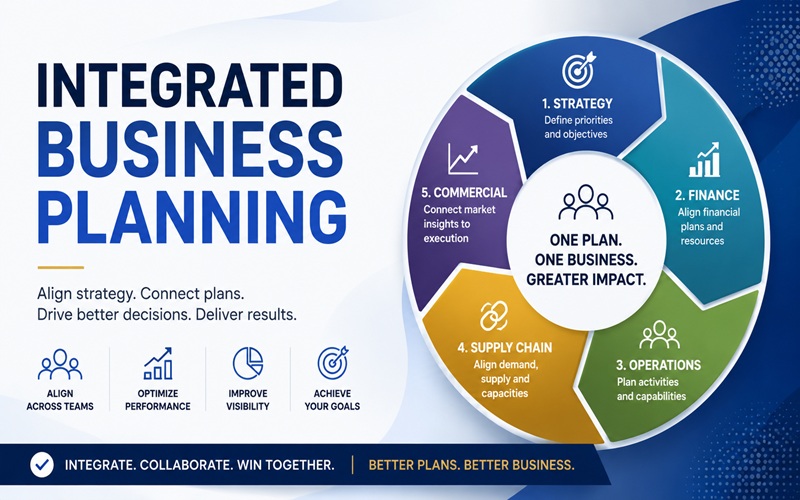
Every organization plans. Sales teams build revenue forecasts. Operations teams build production schedules. Finance teams build budgets. HR teams build headcount plans. The problem that integrated business planning exists to solve is that these plans are built separately, reconciled inadequately, and frequently contradict each other in ways that create operational disruptions, missed commitments, and financial surprises that nobody saw coming because nobody was looking at the full picture simultaneously.
Integrated business planning is the process discipline and organizational structure that connects these separate planning activities into a coherent, continuously updated picture of where the business is going and whether the plans across all functions are aligned and executable. Understanding what it actually involves, how it differs from the planning processes it’s designed to replace, and why implementations so frequently fall short of their objectives is worth doing carefully before committing to a transformation that touches every function in the organization.
The Origin: Sales and Operations Planning Evolved
Integrated business planning, commonly abbreviated IBP, is the evolved form of Sales and Operations Planning, or S&OP, the supply chain planning discipline that became widespread in manufacturing companies from the 1980s onward. S&OP was designed to align sales forecasts with production capacity, ensuring that what sales committed to selling could actually be produced and delivered without creating inventory imbalances or capacity crises.
S&OP solved real problems in manufacturing environments where the disconnect between sales commitments and production capability created expensive disruptions. Its limitation was scope: it connected sales and operations but left finance, HR, product development, and strategic planning largely outside the process. Decisions made in those functions affected and were affected by the sales and operations balance but weren’t systematically incorporated into the planning process.
Integrated business planning, most fully articulated by Oliver Wight International from the early 2000s onward, extended the S&OP concept to encompass all functions of the business in a single integrated process. The monthly IBP cycle reviews the plans of every major function, identifies the gaps and conflicts between them, escalates decisions that can’t be resolved at the functional level to senior leadership, and produces a single integrated plan that everyone commits to executing.
The distinction between S&OP and IBP is therefore primarily one of scope rather than methodology. S&OP operates primarily in the supply chain domain. IBP operates across the entire business, with finance as an equal participant rather than a downstream recipient of the operational plan.
The IBP Process: How It’s Supposed to Work
The IBP process follows a defined monthly cycle with a series of review meetings that build from functional reviews through to an executive review where the integrated plan is approved. Understanding the structure of the cycle reveals both the logic of the process and the organizational demands it creates.
The product management review typically opens the monthly cycle and focuses on the product portfolio: new product launches, product changes, end-of-life decisions, and the assumptions about volume and timing associated with each. Changes to the product portfolio have downstream implications for demand, supply, and financial performance that every subsequent review in the cycle needs to incorporate.
The demand review consolidates the commercial view of what the business expects to sell across all markets, channels, and customer segments over a rolling planning horizon that typically extends eighteen to twenty-four months. The demand review reconciles input from sales, marketing, and market intelligence into a single unconstrained demand plan that represents the best available view of market opportunity before supply or financial constraints are applied.
The supply review tests the demand plan against supply capability, identifying gaps where demand exceeds available capacity and decisions are required about capacity investment, outsourcing, inventory pre-building, or demand shaping. The supply review produces a constrained supply plan that reflects what the business can actually produce and deliver rather than what the demand plan requests.
The financial appraisal translates the operational plans from the demand and supply reviews into financial projections that can be compared against the business’s financial targets. This is the review where the integrated business plan confronts financial reality: if the operational plan as constructed doesn’t deliver the financial performance required, the gap needs to be resolved through changes to the plan rather than carried forward as an unaddressed variance.
The management business review, typically chaired by the CEO or general manager, is the culmination of the monthly cycle where the integrated plan is reviewed, unresolved gaps and decisions are addressed at the executive level, and the business commits to executing the approved plan. This review is where IBP is either a genuine decision-making process or a performance theater exercise, depending on whether the decisions made actually change what the business does.
What Makes IBP Different From Traditional Planning
The differences between IBP and traditional functional planning processes are structural as much as procedural, and they explain both why IBP produces better outcomes when it works and why it’s difficult to implement.
A single integrated number replaces multiple conflicting versions of the plan. In most organizations without IBP, different functions operate from different versions of the plan. Sales has its forecast. Operations has its production schedule. Finance has its budget. These numbers are rarely identical, and the reconciliation between them happens through informal conversations, workarounds, and after-the-fact explanations rather than through a structured process that surfaces and resolves conflicts before they create operational problems.
A rolling horizon replaces the annual budget as the primary planning document. Traditional budgeting produces a twelve-month plan locked in annually that becomes progressively less relevant as the year unfolds and market conditions change. IBP produces a rolling eighteen to twenty-four month plan that is updated monthly to reflect the current best view of the future. The rolling horizon means the business is always planning a consistent distance into the future rather than watching the annual plan become stale over the course of the year.
Decision-making is separated from reporting. A dysfunctional planning process spends most of its meeting time reporting what has happened and little time deciding what to do differently. IBP is designed to spend most of its time on forward-looking decisions about the gaps between plan and capability and how to close them, with historical reporting as context rather than the primary content.
Accountability for plan accuracy is established across functions. In functional planning, a sales team that consistently over-forecasts absorbs no direct consequence because the operational costs of holding excess inventory or building capacity that isn’t needed are borne by the operations and finance functions. In IBP, forecast accuracy is measured and visible, and the functional teams responsible for planning are accountable for improving it over time.
The Technology Layer
IBP is a process discipline that can be executed with spreadsheets, though the limitations of spreadsheets become apparent quickly as planning complexity increases. Dedicated IBP and S&OP software platforms support the process with capabilities that manual tools can’t match at scale.
SAP Integrated Business Planning is the most widely deployed enterprise IBP solution and is the natural choice for organizations already running SAP ERP. It provides demand sensing, supply planning, financial integration, and scenario analysis capabilities within a single platform that integrates directly with SAP’s ERP data. The implementation complexity and cost position it at the large enterprise end of the market.
Anaplan has built a strong position in the IBP market through its connected planning platform that combines financial, operational, and workforce planning in a flexible modeling environment. Its strength in the financial planning component of IBP, which many supply chain-oriented IBP tools handle less effectively, makes it a natural fit for organizations where the financial appraisal step of the IBP cycle is the most sophisticated component.
o9 Solutions and Kinaxis RapidResponse are leading supply chain planning platforms that have extended into IBP by adding financial planning and executive review capabilities to their core supply chain planning functionality. They’re well-suited to organizations where the supply chain complexity is the primary planning challenge and the financial integration is secondary.
Oracle Cloud IBP, Blue Ridge, and Logility represent additional options across the enterprise and mid-market segments. Microsoft’s planning capabilities through Power BI and Excel remain in use at many organizations that don’t have the scale to justify dedicated IBP platforms, with the limitations that spreadsheet-based planning creates in data integrity, scenario analysis, and collaborative updating.
The technology is an enabler rather than the solution. Organizations that implement IBP software without addressing the process design and behavioral changes required to make IBP work typically produce expensive technology deployments that replicate existing dysfunctional planning behaviors in a more sophisticated interface.
Why IBP Implementations Fail
The failure rate for IBP implementations is high enough to be acknowledged honestly. Several patterns in failed implementations appear consistently.
Executive sponsorship that is nominal rather than active is the most common single factor in IBP failure. IBP requires senior leaders to commit to the process, participate genuinely in the management business review, and hold their organizations accountable for plan quality and decision-making discipline. When executives approve the IBP initiative but delegate their participation to subordinates, the process loses the authority and organizational weight required to override functional optimizations with integrated decisions. The monthly management business review becomes a status briefing rather than a decision-making forum.
Siloed data and planning that predates IBP creates the technical and cultural barriers that make integration difficult. Organizations where each function maintains its own planning data in its own systems, uses its own assumptions and terminology, and operates on its own planning calendar have built infrastructure for disconnection rather than integration. Overcoming this infrastructure requires both technical integration work and the organizational change management to shift behavior away from functional optimization toward integrated performance.
Process design that mirrors the existing dysfunction rather than redesigning it produces IBP in name only. Organizations that take their existing monthly planning meetings and rename them IBP reviews without changing the content, participants, or decision-making authority have spent implementation budget and management attention without addressing the root causes of planning disconnection.
Unrealistic timelines for capability development lead to premature declarations of IBP success that aren’t supported by actual capability improvement. Oliver Wight’s Class A benchmark, the recognized standard for IBP maturity, typically takes two to four years for large organizations to achieve even when the implementation is well-executed. Organizations that expect to transform their planning capabilities in six months are consistently disappointed and often abandon the effort before the process improvements have had time to produce measurable results.
Metrics that measure process adherence rather than business outcomes track whether people are attending the meetings and producing the required outputs rather than whether the planning decisions being made are better than before. Measuring IBP success through plan accuracy improvement, customer service level improvement, inventory reduction, and financial forecast accuracy connects the process to the business outcomes that justified the investment.
The Behavioral Change That Makes IBP Work
The technical and process elements of IBP are well-documented and implementable by any organization with adequate resources and commitment. The behavioral changes required are harder to specify and significantly harder to produce.
Functional leaders need to subordinate their functional optimization to the integrated plan. A sales leader whose incentives are tied to revenue bookings and whose natural instinct is to protect optimistic forecasts against operational skepticism needs to commit to forecast accuracy that may be lower than what they’d like to show. An operations leader whose natural instinct is to build inventory buffers against demand uncertainty needs to commit to the lean inventory levels that the integrated plan targets. These behavioral changes run counter to the functional incentives that existed before IBP and require explicit realignment of performance management to support integration.
Honest assessment of gaps requires a psychological safety that planning processes often lack. In organizations where presenting a plan with gaps is treated as a failure rather than as accurate information that enables good decisions, planners learn to present optimistic plans that hide gaps rather than transparent ones that surface them. IBP works when gap identification is rewarded because it enables resolution, and fails when it’s punished because gaps stay hidden until they become crises.
Decision rights need to be clarified and respected. IBP generates decisions that cross functional boundaries, and the authority to make those decisions needs to be unambiguous. Organizations where functional leaders challenge integrated decisions through back-channel conversations or simply don’t execute them undermine the process regardless of its formal design.
IBP in Different Business Contexts
IBP was developed primarily in manufacturing environments and remains most mature in that context. Its application in service businesses, financial services organizations, and technology companies has grown but requires adaptation that reflects the different planning drivers in those environments.
In service businesses, the supply planning component focuses on workforce capacity and capability rather than production scheduling and inventory. Demand planning drives staffing decisions rather than manufacturing runs. The financial integration is equally important as in manufacturing, but the operational drivers are fundamentally different and the IBP process design needs to reflect those differences rather than transplanting manufacturing IBP frameworks directly.
In financial services, IBP connects product planning, revenue forecasting, risk capacity, and capital allocation in a planning process where regulatory constraints and risk management disciplines add complexity that manufacturing IBP doesn’t typically address. The integration between business planning and risk management is a distinctive feature of financial services IBP that requires specific process design rather than adaptation of standard frameworks.
In technology and software businesses, IBP connects product roadmap planning, engineering capacity, go-to-market planning, and financial forecasting in a process where the product development cycle and the market adoption curve are the primary planning uncertainties rather than physical supply constraints. The planning horizons, the sources of uncertainty, and the trade-off decisions that IBP is designed to surface and resolve are different in ways that require thoughtful process adaptation.
Measuring IBP Maturity and Success
The Oliver Wight Class A Checklist for Business Excellence is the most widely used framework for assessing IBP maturity and identifying the gaps between current capability and best practice. It evaluates the process, data, technology, and behavioral dimensions of IBP against defined standards and produces an assessment that guides improvement priorities.
Organizations that use the Class A framework as a continuous improvement tool rather than a compliance exercise derive the most value from it. Regular self-assessment against the checklist criteria, honest identification of the gaps, and systematic work to close them over time is the development path that eventually produces the Class A maturity level where IBP is delivering its potential value.
The Oliver Wight International organization, the originator and primary thought leader in IBP methodology, publishes the most comprehensive body of practitioner guidance on IBP implementation, including books, assessment frameworks, and case studies from organizations that have successfully implemented the process at various scales and in various industry contexts.
The Realistic Expectation
IBP is genuinely capable of producing the outcomes that justify its implementation: better plan quality, faster decision-making, reduced operational surprises, improved customer service performance, and tighter financial forecasting. These outcomes are real and documented in organizations that have implemented IBP with the process discipline, executive engagement, and behavioral change required to make it work.
They are not automatic outcomes of installing IBP software or renaming existing planning meetings. The gap between the organizations that achieve IBP’s potential and those that produce expensive implementations without proportionate results is almost entirely explained by the factors discussed above: executive commitment that is active rather than nominal, process design that addresses root causes rather than symptoms, and behavioral change that aligns functional incentives with integrated performance.
The investment required to close that gap is significant in management attention, organizational disruption, and sustained commitment over a multi-year development timeline. Organizations that enter an IBP implementation with honest expectations about what that investment requires are positioned to achieve what IBP can actually deliver. Those that expect IBP software to solve their planning problems without the organizational work will add to the substantial body of evidence that technology alone doesn’t transform planning capability.