
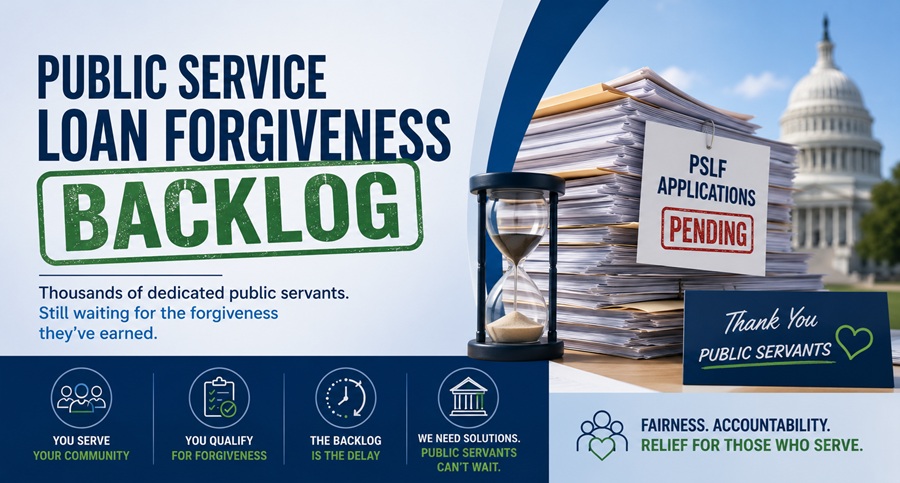
For hundreds of thousands of teachers, nurses, social workers, government employees, and other public servants across the United States, the Public Service Loan Forgiveness program represents something deeply personal: the promise that a decade of service to their communities would be rewarded with relief from student debt. That promise, written into federal law in 2007, has always been complicated to fulfill. In 2026, it has become even harder to navigate. A growing backlog of unprocessed applications, a major repayment plan struck down by courts, and a wave of new federal regulations have created one of the most confusing environments for PSLF borrowers in the program’s history.
How the PSLF Backlog Reached This Point
To understand where things stand today, it helps to trace how the backlog developed. The PSLF program requires borrowers to make 120 qualifying monthly payments while working full time for an eligible government agency or nonprofit employer. After reaching that threshold, the remaining loan balance is forgiven.
In recent years, a provision called PSLF Buyback was introduced to help borrowers who had qualifying employment during periods when they could not make standard payments, such as during administrative forbearances or while enrolled in repayment plans affected by litigation. The Buyback program allows those borrowers to retroactively pay for missed months and apply them toward their 120-payment count.
The problem is that the Department of Education has been unable to process Buyback applications at anything close to the rate they are being submitted. As of the end of February 2026, the Department had a backlog of 88,170 PSLF Buyback applications, up from 83,370 just two months earlier in December 2025. During February alone, the Department received 4,180 new applications but cleared fewer than that number, meaning the queue is still growing despite some processing activity. At the processing rates seen through early 2026, borrowers at the back of the line face a wait estimated at 27 months or more.
The Department officially states that Buyback applications should be processed within 45 business days, which translates to roughly nine weeks. The actual experience of borrowers tells a different story. Data compiled from borrower communities puts the real average processing time at approximately 8.7 months, with some borrowers waiting as long as 16 months without resolution.
Real People Stuck in the Queue
Behind these numbers are real people whose financial lives have been put on hold. Katy Punch, a librarian in North Carolina, calculated that she became eligible for full PSLF forgiveness in November 2024 and submitted her Buyback application shortly after. More than 14 months later, she was still waiting, setting aside extra savings as a buffer in case her forgiveness never materialized.
Her story is not unusual. The American Federation of Teachers filed a lawsuit against the Department of Education in March 2025 over its failure to process IDR and PSLF applications at adequate speed. In a negotiated settlement, the Department agreed to reopen certain income-driven repayment plans and accelerate processing of outstanding applications. Despite that commitment, the Buyback backlog continued to grow in the months that followed, prompting the AFT to return to court in early 2026 seeking further relief.
As Brookings Institution’s comprehensive analysis of the PSLF program notes, by January 2026 over 1.2 million borrowers had received $90.6 billion in forgiveness, corresponding to average relief of nearly $75,000 per borrower. The program is working for those who successfully navigate it. The challenge is that navigating it has become increasingly difficult amid processing delays, policy changes, and legal uncertainty.
The SAVE Plan Collapse and Its Ripple Effects
The backlog problem cannot be understood separately from what happened to the Saving on a Valuable Education repayment plan. SAVE was introduced under the Biden administration in 2023 and quickly became the most affordable federal repayment option ever offered, with some borrowers qualifying for monthly payments as low as $0 based on their income and family size. Over 7 million borrowers enrolled.
In March 2026, the U.S. Court of Appeals for the Eighth Circuit permanently ended the SAVE plan, ruling in favor of a coalition of Republican-led states that argued the Biden administration had exceeded its authority in creating the program. The court directed a district judge to finalize a settlement between the Trump administration and Missouri, which officially terminated SAVE and required the Department to transition all enrolled borrowers to other repayment plans.
This ruling has direct consequences for PSLF borrowers. Many of those enrolled in SAVE were counting on months spent in administrative forbearance during the SAVE litigation to count toward their 120-payment total through the Buyback program. With the plan now permanently terminated and borrowers facing the prospect of higher monthly payments under alternative plans, the stakes of the Buyback backlog have become significantly higher. Borrowers who would have had low or zero payments under SAVE now face larger required contributions under Income-Based Repayment or other plans while simultaneously waiting for their Buyback applications to be processed.
New Regulations Take Effect in July 2026
Adding another layer of complexity, the Department of Education published final PSLF regulations on October 30, 2025, following an executive order signed by President Trump in March 2025 directing the program to be revised. Those regulations take effect on July 1, 2026.
The core change in the new rule involves the definition of a qualifying employer. Under the updated framework, organizations that engage in activities deemed to have a substantial illegal purpose, including supporting terrorism or aiding illegal immigration, will no longer qualify as PSLF eligible employers. The Department received nearly 14,000 public comments on the proposed rule before finalizing it.
For most public servants working in traditional government agencies, public schools, and established nonprofits, this change is unlikely to affect their eligibility directly. However, borrowers working for organizations whose work touches on immigration advocacy, legal services for undocumented individuals, or related fields may face increased uncertainty about whether their employer still qualifies. Legal advocacy groups have signaled they intend to challenge this aspect of the rule.
What Borrowers Should Do Right Now
Given the complexity of the current environment, public servants pursuing PSLF need to be more proactive than the program’s original design ever intended them to be. There are several concrete steps worth taking regardless of where you are in the process.
If you are enrolled in the SAVE plan, the first priority is to understand your alternative repayment options now rather than waiting for the Department to contact you. Moving to Income-Based Repayment will preserve your qualifying payment count and keep you on track for PSLF. Moving to the Standard Repayment Plan is another option that experts recommend for borrowers who are close to their 120-payment threshold and want to keep accumulating qualifying payments immediately.
If you have already filed a PSLF Buyback application and are waiting, experts advise against canceling your application even given the long wait times. Some borrowers who filed Buyback applications and continued making regular qualifying payments have reached 120 payments through the normal monthly process before their Buyback application was ever decided, effectively achieving forgiveness through the standard pathway. This means the backlog may partially resolve itself for borrowers who are close to the finish line through continued regular payments.
Submit your Employment Certification Form annually rather than waiting until you think you are ready to apply for forgiveness. Annual submissions allow you to catch and correct errors in your payment count before they compound over years. MOHELA, the servicer that handles PSLF applications, can flag issues with employer eligibility or payment counts while you still have time to address them.
The Structural Problem Nobody Wants to Fix
The deeper issue underlying the PSLF backlog is a staffing and infrastructure problem inside the Department of Education that has been years in the making. In early 2025, the Trump administration reduced the Department’s workforce significantly, including cuts to staff who processed student loan applications and assisted borrowers. Processing a program as complex as PSLF requires experienced personnel who understand the nuances of qualifying employment verification, payment count reconciliation, and the various pathways to forgiveness. Reducing that workforce while the volume of applications is growing is a structural contradiction that no amount of legal settlement agreements can fully resolve without restored capacity.
For borrowers, the unfortunate reality is that the program they were promised is still technically available but increasingly difficult to access. The forgiveness at the end of the pathway is real. Over $90 billion has been discharged for more than a million borrowers who successfully navigated it. The path to get there has simply become longer, more uncertain, and more dependent on borrowers advocating actively for their own progress rather than trusting the system to work on their behalf.
This article is for informational and educational purposes only. For guidance specific to your loan situation, please consult a certified student loan advisor or visit the official Federal Student Aid website at studentaid.gov