
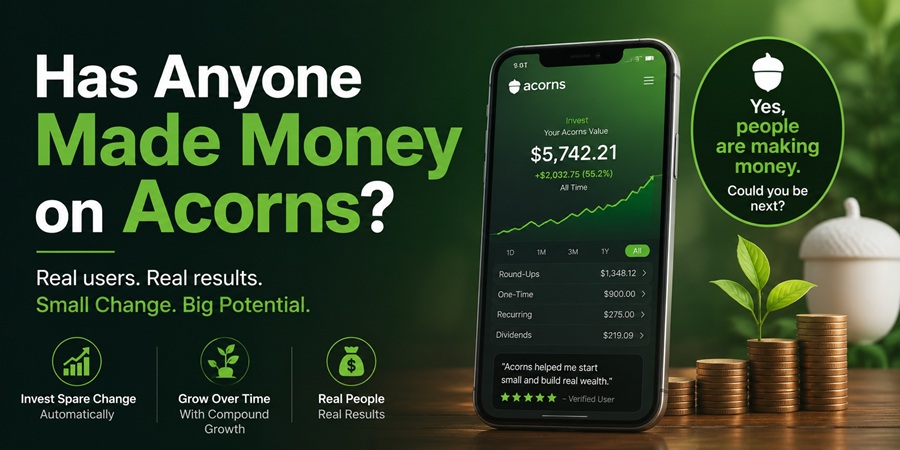
If you have ever scrolled past an Acorns ad promising that spare change can grow into real wealth, you probably had at least one moment of skepticism. The concept sounds almost too simple — round up your everyday purchases to the nearest dollar, invest the difference, and watch it compound over time. But does it actually work? Have real people made real money using this app, or is it just a cleverly marketed way to chip away at your returns through monthly fees?
The honest answer is that yes, plenty of people have made money on Acorns. But how much, and whether it is actually worth it for you, depends on a few factors that the app’s marketing materials tend to gloss over.
How Acorns Works and Who It Is Built For
Acorns is a micro-investing app that launched in 2014 with a straightforward idea: make investing so automatic that people who would never otherwise start actually do. The signature feature is Round-Ups, which links to your debit or credit card and rounds each purchase up to the nearest dollar, sweeping that spare change into a diversified portfolio of low-cost ETFs.
So if you buy a coffee for $3.60, Acorns invests $0.40. Do that across dozens of daily transactions and the contributions add up faster than most people expect. According to Acorns, customers who use Round-Ups invest an average of $45 per month through that feature alone. That is not a trivial amount when it compounds consistently over years.
Beyond Round-Ups, users can set up recurring daily, weekly, or monthly deposits, and the app offers portfolio options ranging from conservative bond-heavy allocations to aggressive equity-focused ones. By early 2026, Acorns had accumulated over 14 million all-time customers and over $30 billion invested through the platform. Those numbers suggest it is doing something right.
What Real Users Are Actually Saying
The user feedback landscape for Acorns is genuinely mixed, and the split reveals a lot about who the app works for and who it does not.
On the positive side, the most consistent theme across reviews on Reddit, the App Store, and Trustpilot is that Acorns helped people build an investing habit they simply could not maintain on their own. As one App Store reviewer wrote in early 2026, “I’ve been using it for 3 years. The round-ups alone built $1,800 without me noticing. Now I have recurring deposits set up too.” That outcome is common. The automation removes the friction and the willpower requirement that stops most people from investing in the first place.
Users on higher plan tiers who take advantage of Acorns Later, the app’s IRA feature, also highlight the IRA match as an underrated perk. Silver and Gold subscribers receive a percentage match on their IRA contributions, which effectively offsets part of the subscription cost for people who use that feature actively.
On the negative side, the most consistent complaint is the fee structure for users with small balances. Acorns charges a flat monthly fee ranging from $3 to $12 depending on the subscription tier, and for someone with a $400 account balance on the $3 plan, that works out to around 9 percent annually in fees before a single dollar of market return. That is an extraordinarily high expense ratio compared to robo-advisors like Betterment or Wealthfront, which charge a flat 0.25 percent of assets. One Reddit user in a personal finance thread put it plainly: “I was paying $3 a month, but my balance was only around $400. That’s more than 9% annually just in fees. Moved to another platform.”
The Fee Problem Is Real — But It Has a Tipping Point
This is the central tension with Acorns and it deserves an honest explanation rather than a dismissal.
As NerdWallet’s 2026 review of Acorns notes, the monthly fee structure can be significant for small balances, which is a meaningful concern given that the app’s entire premise is built around attracting people who are starting from nearly nothing. The math is not complicated. If your portfolio earns 8 percent annually but your fees consume 9 percent, you are moving backwards.
The tipping point is roughly the $5,000 mark. Once your Acorns balance reaches that level on the $3 per month plan, your annual fee drops to around 0.72 percent of assets, which is higher than a pure robo-advisor but not outrageous for a platform that also includes banking features and automatic rebalancing. At $10,000, it drops to around 0.36 percent, which is competitive. The longer you stay and the more you contribute, the more the fee math works in your favor.
What the Returns Actually Look Like
Acorns invests in a mix of ETFs across stocks and bonds, built on portfolios designed by Nobel Prize-winning economist Harry Markowitz. The aggressive portfolio, which is mostly equities, has historically returned roughly 8 to 10 percent annually before fees over long periods, consistent with broad market performance. The conservative portfolio delivers lower returns but with reduced volatility, making it better suited to users who cannot stomach big swings.
These are not exotic returns. You are essentially getting market-rate performance, which is exactly what you should expect from a passive ETF-based strategy. The value proposition of Acorns is not that it generates superior returns. It is that it gets people invested who would otherwise keep their money in a checking account earning nothing at all, and it keeps them invested automatically through market ups and downs.
The Hidden Cost Nobody Talks About When Leaving
One aspect of Acorns that catches users off guard is the exit cost. If you decide to transfer your holdings to another broker rather than liquidating them, Acorns charges $50 per ETF. Since the aggressive portfolio holds six ETFs, a full transfer-out could cost $300. Some users have reported being blindsided by this when trying to move to a lower-cost platform after their balance grew large enough to justify it.
This is not a dealbreaker, but it is worth knowing going in. Most users with smaller balances simply liquidate rather than transfer, which means selling everything, receiving cash, and re-investing elsewhere. Depending on timing and tax situation, this can have consequences.
So Has Anyone Actually Made Money on Acorns?
Yes, clearly and consistently. Millions of people have used the platform to build genuine investment balances from near zero, often without significantly changing their spending behavior. The Round-Ups feature in particular has proven to be a psychologically powerful tool because it does not feel like saving. You do not miss money you never mentally counted as yours.
Whether Acorns is the right platform for you long-term is a different question. For absolute beginners who need an automated nudge to start investing, it is one of the best entry points available. For users who are disciplined enough to make recurring deposits and comfortable enough to use a traditional robo-advisor, the math eventually favors moving to a lower-cost alternative once their balance climbs.
Think of Acorns as a financial training wheel that genuinely works. It builds the habit, it builds the balance, and then at some point it may make sense to graduate to a platform whose fee structure scales with what you have built.
This article is for informational purposes only and should not be considered financial advice. Please consult a qualified financial advisor regarding your personal investment decisions.