
The paper business card has been declared dead so many times that the declarations have become a running joke in professional circles. But the underlying critique has always had merit: a small piece of cardboard with static information that gets lost in pockets, forgotten in drawers, and discarded during desk cleanups is a genuinely inefficient way to transfer professional contact information in an era where everyone has a smartphone.
Popl is one of several companies that has built a product around solving this problem using near-field communication technology, and it has become the most recognized brand in the digital business card space. Whether it delivers on its premise depends significantly on how you intend to use it and whether your professional context is one where its specific advantages actually matter.
What Popl Is
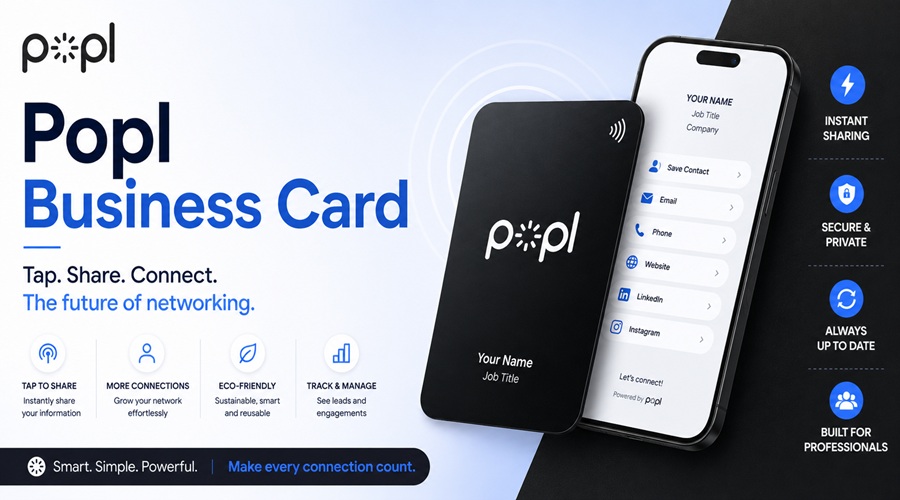
Popl is a digital business card platform that uses NFC technology to share contact information and professional profiles with a tap. The physical product is a thin chip embedded in a card, wristband, phone accessory, or other form factor that, when tapped against an NFC-enabled smartphone, opens a customizable profile page in the recipient’s browser without requiring them to download an app.
The profile page can include contact information, links to social media profiles, a website, a portfolio, a calendar booking link, a payment link, and any other digital resource the user wants to share. The recipient can save the contact directly to their phone or follow any of the links on the profile. The sender’s information is updated in real time, meaning that if the phone number, title, or company changes, the same physical Popl card reflects the updated information without requiring a reprint.
NFC, near-field communication, is the same technology used in contactless payment systems. Most smartphones manufactured after 2018 support NFC, though iPhone users need iOS 13 or later to trigger NFC tags without opening a specific app. Android devices have supported background NFC tag reading for longer. The practical implication is that Popl works for the large majority of smartphones in current use, with the caveat that a small number of older devices may not support it.
The Product Line
Popl offers several physical product formats that cater to different use cases and preferences.
The Popl Card is the most direct replacement for a traditional business card, sized similarly and available in several materials including PVC, metal, and bamboo. It functions as a standalone card that can be handed to someone who taps it with their phone. Unlike a traditional business card, it contains no printed information beyond the Popl branding and an optional QR code on the back, relying entirely on the NFC tap or QR scan to deliver the profile. Prices for the card start at approximately $15 for the basic version and run to $50 or more for metal versions.
The Popl Phone accessory attaches to the back of a phone as a pop socket or adhesive tag, allowing the user to tap their phone against the recipient’s phone rather than carrying a separate card. This format works well for frequent networkers who want the card accessible without carrying it separately but creates a slight awkwardness in the interaction since it requires close proximity between two phones.
Popl for Teams is the enterprise product that allows organizations to create and manage profiles for all employees through a central dashboard, ensuring brand consistency across the team’s digital cards and providing analytics on engagement. Pricing scales with team size and ranges from several dollars to over ten dollars per user per month depending on the plan and features.
The Popl QR code option generates a scannable code that can be displayed on a phone screen or printed on materials, providing a fallback for contacts whose phones don’t support NFC or who prefer QR scanning. Most Popl physical products include a QR code as well as NFC, providing both methods in the same product.
How the Profile Works
The profile created through Popl’s platform is the core of the product’s value, and its quality depends entirely on how it’s configured.
The free Popl account provides a basic profile with limited customization. The paid Popl Pro subscription, priced at approximately $7.99 per month or $47.88 per year, unlocks full customization including custom backgrounds, colors, fonts, and profile sections. It also adds features including contact capture, which allows the user to collect the contact information of the people they share their profile with rather than only providing their own information, lead management tools, and analytics showing how many people have viewed and engaged with the profile.
The contact capture feature addresses one of the key limitations of the one-directional nature of digital card sharing. When someone taps a Popl card, they receive the cardholder’s information, but the cardholder doesn’t automatically receive theirs. Contact capture creates a form that prompts the recipient to share their information in return, which collects leads rather than simply distributing contact information.
The profile supports integration with CRM systems including Salesforce and HubSpot, allowing contacts captured through Popl to be automatically added to the business’s CRM rather than requiring manual entry. For sales professionals and frequent networkers who track contacts systematically, this integration eliminates the friction between the initial exchange and the follow-up that determines whether the connection produces commercial value.
Popl for Teams: The Enterprise Use Case
Popl’s most commercially significant product is its Teams platform, which addresses a genuine pain point for organizations that want consistent, professional digital card sharing across their workforce.
Traditional paper business cards for large teams involve printing costs, minimum order quantities, the lag time between an employee starting and their cards arriving, the waste of reprinting when information changes, and the impossibility of updating cards that have already been distributed. A salesperson whose title changes, a company that rebrands, or a team that gains new phone numbers can’t update distributed paper cards after the fact.
Popl for Teams solves all of these problems. New employees can have a functioning digital card within minutes of the account being created. Organizational information including logo, brand colors, and company details is managed centrally and reflects consistently across all team profiles. Individual employees customize their personal information within the organizational template. Analytics provide visibility into card sharing activity across the team.
The pricing for Teams starts at approximately $7.99 per user per month for the Pro plan and includes centralized dashboard management, brand controls, and basic analytics. Enterprise pricing with advanced CRM integration, single sign-on, and dedicated support requires direct engagement with Popl’s sales team.
For organizations where consistent professional presentation, real-time information accuracy, and lead capture from networking activity are genuine priorities, the Teams product addresses those needs more effectively than paper cards at a cost that is competitive with traditional printing for organizations that reprint cards with any regularity.
How Popl Compares to Alternatives
The digital business card market has several players beyond Popl, and understanding how they compare helps clarify whether Popl is the right choice or whether an alternative better fits the specific use case.
HiHello is Popl’s most direct competitor, offering similar NFC card, digital profile, and team management functionality. HiHello’s free tier is more generous than Popl’s, offering card sharing without the limitations that push free Popl users toward the paid subscription. Its enterprise features and integrations are comparable to Popl’s, and the choice between them often comes down to interface preference and specific feature comparisons rather than categorical differences.
Blinq offers digital card functionality with a strong emphasis on QR code sharing rather than NFC, making it slightly more accessible for users whose contacts have older devices. Its pricing is competitive with Popl and its team management features are solid.
Dot is another NFC business card competitor that has positioned itself with a slightly more premium product aesthetic than Popl. Its profile features are comparable and its physical products are well-reviewed for build quality.
LinkedIn QR codes provide a free alternative that many professionals already use to share their LinkedIn profile in person. For professionals whose primary networking objective is a LinkedIn connection, the LinkedIn QR code eliminates the need for any paid digital card product. Its limitation is that it shares only the LinkedIn profile rather than a customizable page with multiple links and contact details.
Traditional paper business cards remain the relevant comparison for most small businesses evaluating whether digital cards are worth adopting. A box of 500 quality business cards from Moo or Vistaprint costs $30 to $100 depending on the quality and quantity. A single Popl card with an annual Pro subscription costs $60 to $100 in the first year. The paper cards don’t require a subscription to continue working, but they can’t be updated, don’t capture contact information in return, and don’t provide analytics.
The NFC Limitation in Practice
NFC technology works reliably when both devices support it and when the tap is executed correctly. In practice, there are enough situations where NFC sharing doesn’t work smoothly that professional users typically benefit from having a QR code backup, which most Popl products include.
iPhones running older iOS versions, cases that interfere with NFC signal, and the occasional user who doesn’t know how to enable NFC on their Android device all create situations where the tap doesn’t produce the expected result. The awkwardness of a digital card that doesn’t work in a networking moment can undermine the professional impression it was supposed to create.
The QR code on the back of most Popl cards addresses this limitation, providing a fallback that works for any smartphone with a camera. Most current iPhones and Android devices can scan QR codes through the native camera app without requiring a separate app download, making the QR fallback nearly universal.
Who Gets the Most Value From Popl
The professionals and businesses who get the most demonstrable value from Popl share specific characteristics that make the product’s advantages material rather than theoretical.
Frequent networkers who attend multiple events, conferences, or client meetings per month and exchange contact information regularly benefit from the efficiency of digital sharing, the consistency of always having a card available without carrying a physical supply, and the contact capture and CRM integration features that make follow-up systematic rather than dependent on manually processing a stack of received cards.
Sales professionals whose effectiveness depends on consistent follow-up with new contacts benefit from the CRM integration that converts a networking interaction into a managed lead without manual data entry. The analytics showing which contacts engaged with the profile after receiving it provide intelligence about interest levels that paper card exchanges don’t generate.
Organizations with high employee turnover, frequent title or contact information changes, or multiple locations that need consistent brand presentation benefit from the real-time updating and centralized management of the Teams product in ways that justify its cost over paper card printing and reprinting cycles.
Professionals in technology, marketing, design, and other fields where being current and innovative is part of the professional identity benefit from the signal that a digital card sends about their orientation toward current tools and practices.
Who Might Not Need It
The honest assessment of Popl includes the cases where the investment doesn’t produce proportionate value.
Professionals who network infrequently and have stable contact information have limited practical problems that Popl solves. A consultant who attends two conferences per year and whose contact information doesn’t change has little return on a $60 annual subscription for a tool that addresses the inefficiency of paper cards they rarely distribute.
Business contexts where the physical card carries specific cultural significance, including certain industries and international business contexts where the ritual of exchanging business cards has professional significance, may find that digital cards create awkwardness rather than convenience. Japan’s meishi culture, described in the business card standards article earlier in this series, is the clearest example of a context where a digital substitute misses important cultural dynamics.
Very small businesses and sole proprietors whose networking activity is primarily local and relationship-based rather than event-driven may find that the modest investment in quality paper business cards produces equivalent results at lower cost and without any technology dependency.
The Setup Process
Getting started with Popl involves purchasing the physical product, downloading the Popl app, creating a profile through the app, and linking the physical product to the profile. The process takes approximately fifteen to thirty minutes for a complete initial setup including profile customization.
The app is available for iOS and Android and is required for the initial setup and for managing the profile going forward. Profile updates, contact management, and analytics are all handled through the app or the web dashboard. The recipient doesn’t need the app, which is an important usability advantage: sharing through Popl is a one-sided technology requirement where only the sender needs the app.
The Popl website provides current pricing, product comparisons, and documentation on setup and integration with specific CRM platforms, and is the most accurate source for current product details given that pricing and features in the digital business card market evolve regularly.
The Bottom Line
Popl is a genuinely useful product for the professionals and organizations it’s designed for, solving real problems that paper business cards create in high-volume networking contexts. Its NFC technology works reliably in most situations, its profile platform is well-designed, and its Teams product addresses legitimate enterprise use cases around consistency and information currency.
Whether it’s worth the investment depends on the frequency of networking activity, the value of efficient contact capture and CRM integration in the specific professional context, and whether the ongoing subscription cost is justified by the problems it solves relative to simpler and cheaper alternatives including paper cards and LinkedIn QR codes. For frequent networkers and organizations with genuine contact management needs, the answer is frequently yes. For occasional networkers with stable information, the answer is frequently no.