
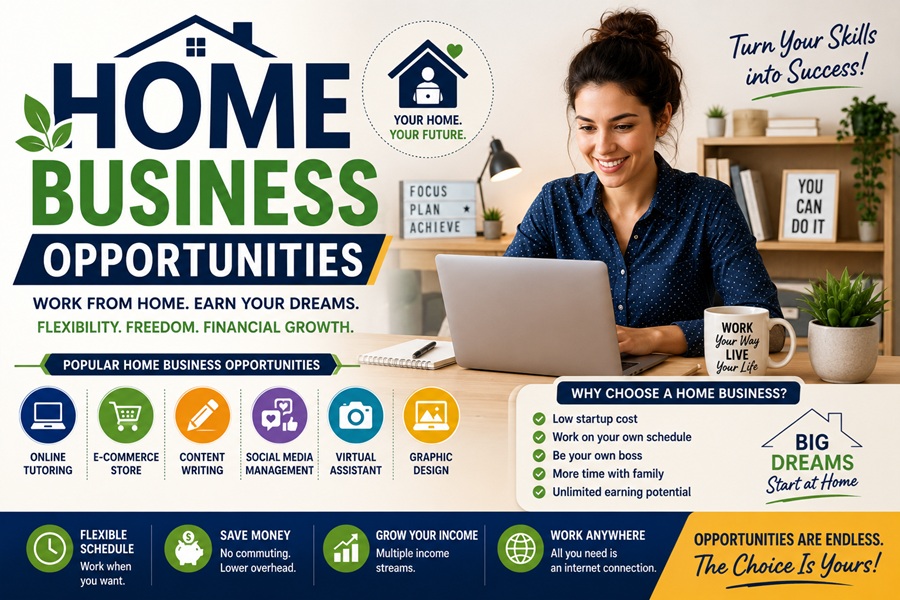
The idea of working from home has gone from fringe preference to mainstream reality over the past several years. But there’s a difference between working from home for an employer and building a business that operates from home — one that you own, control, and can grow on your terms.
The landscape of genuine home business opportunities has expanded significantly. What was once limited to direct sales and childcare has opened into a much wider range of viable models across services, digital products, skilled trades, and creative work. The challenge isn’t finding options — it’s identifying which ones match your skills, schedule, and financial expectations honestly.
Service Businesses You Can Run From Home
Service businesses are often the fastest path from idea to income because the startup costs are low and the value you deliver is your expertise or labor rather than a physical product.
Bookkeeping and accounting services. Small businesses consistently need help managing their finances, and most don’t need a full-time accountant — they need someone reliable a few hours a week. A bookkeeper with basic accounting software knowledge and QuickBooks certification can build a roster of small business clients entirely through referrals. Rates typically run $30 to $75 per hour depending on complexity and location.
Virtual assistance. Administrative support, calendar management, email handling, research, and data entry are all tasks that business owners routinely outsource to remote workers. The skill floor is low, which means competition exists at the entry level — but VAs who specialize in a specific tool, industry, or function (executive support, podcast management, e-commerce operations) command significantly higher rates.
Consulting and coaching. If you have deep professional experience in a specific domain — marketing, HR, operations, finance, technology — that expertise translates directly into a consulting or coaching practice. The primary asset is knowledge and credibility, not infrastructure. Building an initial client base through your existing professional network is typically more effective than paid advertising in the early stages.
Tutoring and instruction. Academic tutoring, music lessons, language instruction, and test preparation all translate well to home-based or online delivery. Video platforms have removed geography as a constraint entirely. Platforms like Wyzant and Lessonface provide client acquisition infrastructure for those starting without an established reputation.
Digital and Online Business Models
The internet has created a category of home business that simply didn’t exist a generation ago — businesses built entirely around digital delivery, where geography is irrelevant and overhead is minimal.
Freelance writing and content creation. Businesses of every size need content — website copy, blog articles, email campaigns, social media, whitepapers, product descriptions. Writers who develop genuine expertise in a specific industry (finance, healthcare, technology, legal) rather than positioning themselves as generalists typically find more consistent, higher-paying work. Platforms like Clearscope and LinkedIn are where serious content clients look.
Graphic design and creative services. Brand identity, marketing materials, social media graphics, and packaging design are in constant demand from small and mid-sized businesses that can’t justify an in-house designer. Like writing, specialization — focusing on a specific industry or deliverable type — commands better rates than generalist positioning.
E-commerce and product selling. Handmade goods on Etsy, private-label products on Amazon, vintage resale on eBay — physical product businesses can be run effectively from home, particularly before they reach a scale that requires warehouse space. The key variable is margin: product businesses require careful attention to cost of goods, shipping, and platform fees to remain profitable.
Online courses and digital products. If you have expertise that others want to acquire, packaging it into a course, template, guide, or toolkit creates a product that can be sold repeatedly without additional time investment per sale. The challenge is distribution — digital products require an audience or traffic source to generate sales consistently.
Home-Based Businesses With Physical Output
Not every home business is purely service or digital. Several models involve physical production or delivery while keeping overhead minimal by operating from home.
Food production. Cottage food laws in most U.S. states permit the production and sale of specific food items — baked goods, jams, confections — from a home kitchen, subject to licensing and revenue caps that vary by state. For culinary entrepreneurs testing market demand before investing in commercial kitchen space, this is a practical starting point.
Handmade and craft production. Candles, soap, jewelry, ceramics, woodworking, and custom apparel are all categories with viable home production models. Platforms like Etsy, local farmers markets, and Instagram have lowered the barrier to finding buyers considerably. Margins vary widely depending on materials and production time.
Pet care and grooming. Dog training, pet sitting, and mobile grooming are service businesses that can originate from home. Pet sitting platforms like Rover provide client acquisition support. Grooming requires equipment investment but can be operated from a garage or dedicated home space with appropriate setup.
What Separates Viable Opportunities From Time Wasters
The home business space is unfortunately crowded with low-quality opportunities that promise passive income with minimal effort. Multi-level marketing schemes, dropshipping courses, and “make money online” programs frequently target people searching for home business ideas — and most deliver poor results relative to the time and money invested.
The filter worth applying to any home business opportunity is straightforward: does the business model generate revenue by delivering genuine value to customers, or does it primarily generate revenue by recruiting new participants or selling the idea of the business itself? The first category contains real opportunities. The second rarely does.
Sustainable home businesses share a few characteristics regardless of model: they solve a real problem for a defined customer, they have clear unit economics that make profitability achievable, and the income potential scales with skill or volume rather than being capped by the model itself.
Getting the Foundations Right
Before launching any home business, a few practical steps protect you legally and financially. Register the business appropriately for your state, open a separate business bank account to keep finances clean from day one, and understand the tax implications of self-employment income — quarterly estimated taxes are a reality that surprises many first-time home business owners.
The IRS Small Business and Self-Employed Tax Center is the most reliable resource for understanding your tax obligations as a home-based business owner, including home office deduction rules that many self-employed people underutilize.
The Honest Assessment
Running a home business is genuinely appealing — the flexibility, the elimination of commute, the control over your schedule and work environment. But it requires self-discipline that an office environment provides by default, and it can blur the line between work and personal life in ways that take deliberate management.
The opportunities are real. The path from idea to sustainable income requires consistent effort, honest self-assessment of your skills and market, and patience through the early months when revenue is building and momentum hasn’t yet arrived. The home businesses that last are built the same way any business is built — by delivering real value, consistently, to people who are willing to pay for it.